
When a young girl disappears after getting off the school bus, the investigation struggles to overcome a slow start. What happened to Amber Harris?
Episode Media


Episode Sources
- Police seek missing girl, 12
- Family, police still looking for Amber
- $1,000 is offered for information about girl
- Family of missing girl questions police probe
- Lead on missing girl ‘pretty sound’
- ‘I paid my debt’ for the past, says dad | Part 2
- Police conduct search for girl
- FBI Joins Hunt for Missing Girl
- Amber Harris’ family clings to hope she’ll be found
- Calling Amber Harris a runaway criticized
- Police release few details in case of Amber Harris | Part 2
- Police, FBI ask public for help | Part 2
- Normal girl, normal day, then what? | Part 2
- Police say rumors that girl was found are false
- Vigil marks month since girl vanished
- Tip on missing girl doesn’t pan out
- Family, friends pray for the return of missing girl
- Amber Harris not found after report of sighting near Bluffs
- Alleged sightings, tips keep family on edge
- Girl’s bookbag may have been found
- Amber’s parents: Bookbag planted | Part 2
- Parents find hope in recovered book bag | Part 2
- Where is she? Label matters to girl’s family | Part 2
- Group prepares to search for Amber Harris
- Search for Amber expands | Part 2
- Seekers of Amber clues return empty-handed
- Police get items found during search
- Events remind public Amber is still missing
- Two sets of remains discovered | Part 2
- Police seek to ID human remains found in a park | Part 2
- Amber’s classmates keep their hopes up
- DNA tests under way on remains | Part 2
- Remains found in park are those of Amber Harris
- Amber’s death a homicide | Part 2
- Friends, neighbors gather to mourn
- Grieving parents angry with police | Part 2
- Amber’s parents say racism slowed police search | Part 2
- Girl with a feisty, creative spirit has touched the whole community | Part 2
- Family, classmates gather to grieve | Part 2
- Service draws large crowd united in grief | Part 2
- Amber Harris timeline
- Sex offender faces new charges | Part 2
- Search included questions on Amber | Part 2
- $3 million sought, but bail set at $100,000 for suspect
- Amber Harris suffered head blow | Part 2
- Ex-girlfriend told of threat of decapitation
- ‘There will never be any closure’ for Harris family | Part 2
- Man pleads no contest to tampering with witness
- Man arrested in murder of Omaha school student
- Police: Book bag led to Ellis | Part 2
- Arrest lets girl’s family inch forward | Part 2
- Inmate: Ellis said he killed Amber | Part 2
- Suspect in girl’s death gets decades in prison | Part 2
- Ellis refuses to attend hearing in murder case
- DNA on slain girl’s pants came from Ellis’ skin
- Sisters tell of Ellis’ abusive past | Part 2
- Tapes contain denials by Ellis | Part 2
- Ellis’ statements, DNA testimony OK for trial
- Thoughts turned to Amber Harris as Ellis’ murder trial began today | Part 2
- Stakes high in selection of Ellis jury | Part 2
- Amber’s parents excluded from trial | Part 2
- Signs of Amber’s life spilled from bag, jury told | Part 2
- Grisly exhibits hard for jurors | Part 2
- Testimony Centers On Discovery Of Amber’s Body
- Ellis trial takes scientific turn | Part 2
- Both sides rest; Ellis doesn’t take stand | Part 2
- Ellis found guilty in Amber Harris death | Part 2
- Roy Ellis convicted himself with careless talk | Part 2
- Jurors hear about Ellis’ past | Part 2
- Jury finds Roy Ellis eligible for execution
- Ellis could face death penalty
- 3-judge panel to decide Ellis’ fate
- Psychiatrists to examine Ellis before sentencing
- Judges consider death penalty in Harris case
- Death sentence gratifies Amber’s kin | Part 2
- Relatives of Amber Harris, other victims stand witness | Part 2
- Remembering Amber Harris ten years later
- Nebraska Supreme Court denies appeal of death row inmate sentenced for killing Omaha girl
- Nebraska Supreme Court denies appeal of death row inmate
- STATE v. ELLIS (2022)
- ELLIS v. Nebraska Department of Correctional Services (2026)
Episode Transcript
Welcome back to Bite-Sized Crime. This week I’m bringing you the story of a missing girl whose story touched her entire community. This episode discusses sensitive topics, so listener discretion is advised.
On the morning of Tuesday, November 29, 2005, Melissa Harris walked her 12-year-old daughter Amber to the bus stop. The weather in Omaha, Nebraska, was cold that morning – overcast and well below freezing – but Amber didn’t like wearing the bulky winter coat her mother had suggested. Instead, the confident, fashionable pre-teen was wearing jeans and a windbreaker over the red sweater she had borrowed from her older sister. When the school bus pulled up around 6:30am, Amber hugged her mom goodbye and told her she loved her.
Amber was in 7th grade at Beveridge Magnet Center, a public middle school in West Omaha that focused on arts and global studies. She had transferred there just a few months prior and seemed to be adjusting well to the transition. Her teachers described her as having a mind of her own, and she sometimes got in trouble for her outspoken ways. But she always did what she thought was right in the moment, and she was always willing to stand up for herself and others.
One of six siblings, Amber was creative and funny, and she wasn’t afraid to show how smart and talented she was. She had dreams of one day becoming a hairdresser and a singer, and everyone talked about her beautiful voice. She had even been asked to perform the National Anthem at a school basketball game. Her whole family had attended the game to cheer her on, and they were so proud of Amber’s performance. They knew her poise and confidence would take her far in life.
Now, Melissa watched as the school bus pulled away from the curb, Amber waving goodbye through the window. She had no idea it would be the last time she would see her daughter.
Around 4:00 that afternoon, Amber called her father from a friend’s cell phone and said she would be taking the late bus home. Amber often stayed after school to tutor younger students or to get extra help on her own assignments. Michael Harris told his daughter to come straight home afterwards, and she promised she would. But as the hours passed and the sun began to set, Amber didn’t come home. The bus ride from the school to the Harris residence in northeast Omaha was a long one, but even with traffic, Amber should have been home before 6:00pm.
Starting to worry that his daughter was alone out in the cold, Michael called his brother and a neighbor for help, and the three men walked the neighborhood together, calling out Amber’s name. But it soon became clear that Amber wasn’t anywhere nearby. At 6:50pm, Michael and Melissa called the Omaha Police Department and reported Amber missing.
Unfortunately, as is often the case, the police seemed to think that Amber was just another teenage runaway. Melissa later recalled an officer telling them that they didn’t know their daughter as well as they thought. But the Harrises knew that Amber would never run away. Melissa told the Omaha World-Herald that Amber was a trustworthy kid with a consistent routine. “When she gets out of school she’s super hungry, and she comes home for a snack and to do her homework. If she wanted to go to someone’s house, she would have come home first.”
Omaha police put out a bulletin with Amber’s description and a request for anyone who saw her to call 911. They didn’t believe she was in danger, but the cold weather did cause some concern for her well-being.
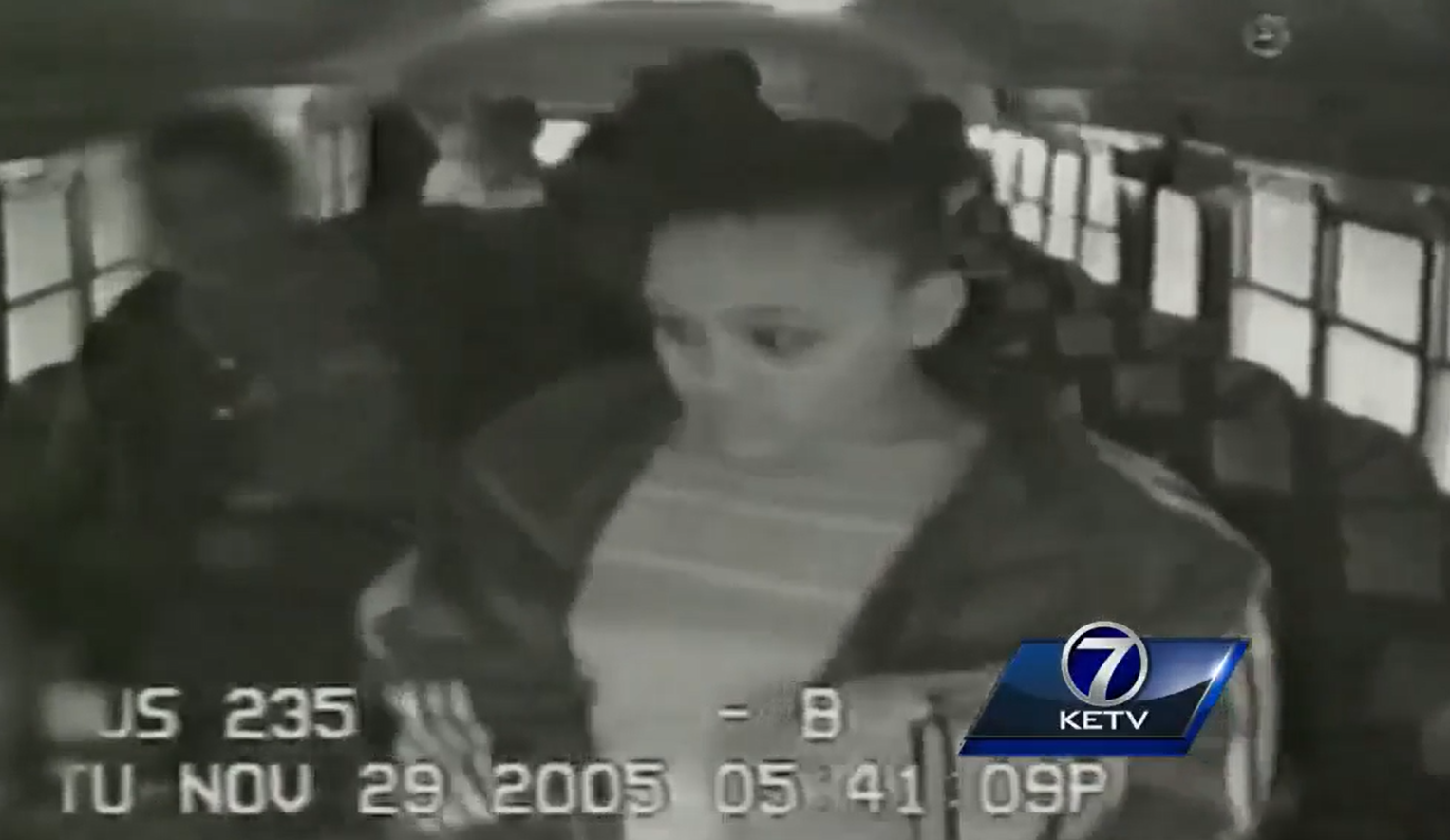
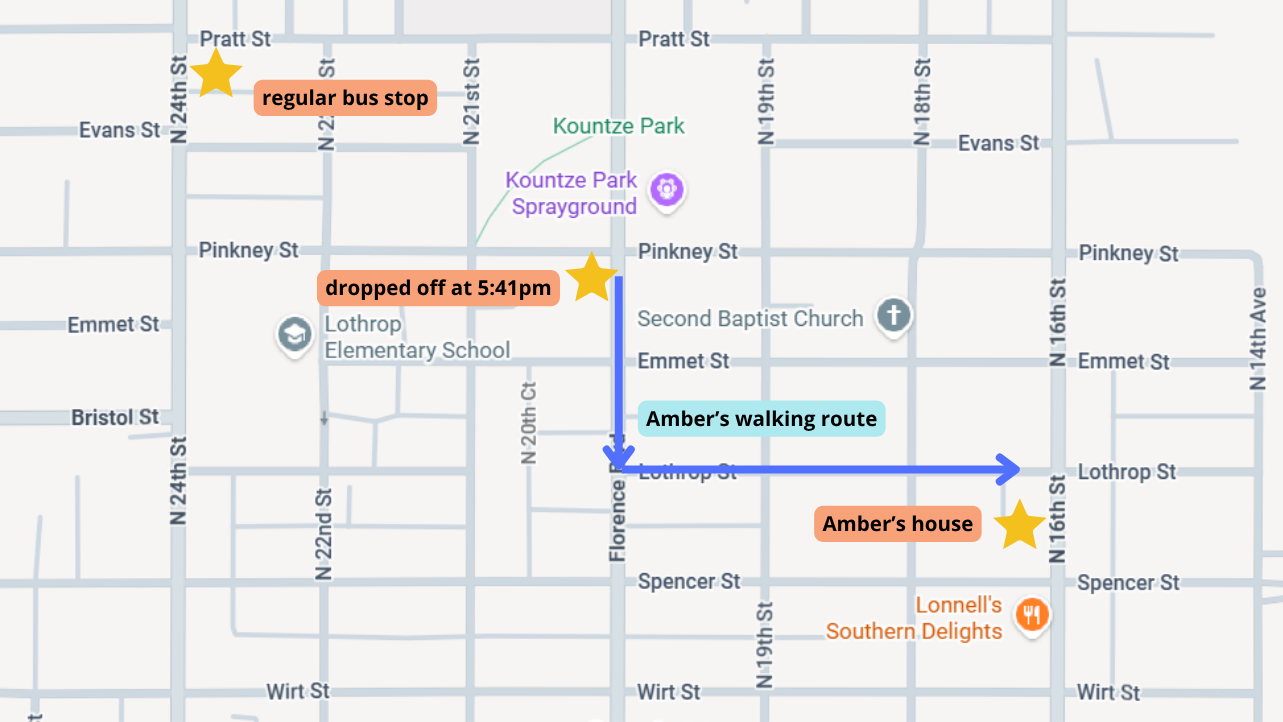
Meanwhile, officials with Omaha Public Schools talked to Amber’s friends and teachers and pulled the camera footage from their school buses to help put together a timeline of the day Amber disappeared. Just like her mother said, Amber got on the bus around 6:30 on the morning of November 29th. At school, she attended all of her classes and completed her assignments. Her teachers said she was in good spirits and nothing seemed out of the ordinary. During her last class of the day, Amber made cards for her family members as part of a writing assignment, thanking her parents for supporting her dreams. At 4:00, she called her dad to tell him she was staying late. At 4:30, she boarded the school bus, sitting near the back. The camera footage showed Amber looking out the window, appearing relaxed and unbothered. An hour later, Amber could be seen wiping makeup off her face, something her parents didn’t allow her to wear. At 5:41pm, the bus stopped at the corner of Florence Boulevard and Pinkney Street, and Amber got off. She walked south down Florence and disappeared from view as the bus pulled away.
Notably, this was not Amber’s usual bus stop. She typically was dropped off at 24th and Pratt Streets, but on this day, she had asked the bus driver to drop her off closer to home. Although it was against protocol, the driver agreed – perhaps because it was getting dark and the temperature outside was dropping rapidly. Amber would only have to walk five blocks instead of her usual nine. It should have taken her less than ten minutes to get home that day – what had gone wrong?
Days passed, and there was still no sign of Amber. On December 4th, volunteers with the Omaha Coalition of Citizen Patrols walked the streets of northeast Omaha, hanging flyers and searching abandoned buildings. Omaha police detectives knocked on doors and talked to neighbors, hoping for new leads. Although Amber’s parents were grateful for the search, they were frustrated that it had taken five days for it to happen.
Instead of launching an immediate search, detectives seemed more focused on investigating Amber’s family. Michael Harris had served time in prison for a 1983 rape conviction when he was 18, and there had been several reports of domestic violence in the Harris home over the years, sparking rumors that Amber had run away from an abusive home life. But both Michael and Melissa maintained that they had worked hard to tackle their issues through counseling and parenting classes. Michael told the World-Herald, “Me and my wife, we love our children. We’re going to keep doing everything we can to get our daughter back.”
On December 11th, police searched a large wooded area between East Locust and North 14th Streets, just a few blocks from the Harris residence. Detectives from the Omaha police child victims unit joined officers on horseback for the search as a police helicopter circled overhead. Unfortunately, the search came up empty.
Two days later, nearly 100 friends and neighbors gathered at the corner where Amber had disappeared just two weeks earlier. They passed out flyers and prayed for Amber’s safe return. Michael Harris addressed the crowd, saying, “We have hope, and we’re not giving up. Baby, we love you, and we want you home with us where you belong.”
As the weeks passed, Amber’s case began to pick up more attention in the media. It was extensively covered by the Omaha World-Herald, and it was even featured on “America’s Most Wanted” and the popular TV show “Without a Trace”. Investigators followed up on every lead and sought assistance from the FBI’s Behavioral Analysis Unit to construct potential scenarios of what could have happened to Amber.
Again, Amber’s parents were grateful that police were finally taking their daughter’s case seriously, but they wondered how it might have been different if police had shown more concern from the get-go. Melissa was white and Michael was Black – had race played a part in the slow response? Melissa told the World-Herald that one of the first questions police had asked them was whether or not Amber was a ward of the state, assuming that she must be in foster care because of the family’s background and Michael’s criminal past. They felt their concerns hadn’t been treated as a priority. In fact, Amber was listed as a runaway in the national database, something they knew to be untrue.
Still, Omaha police defended their choice to delay searching for Amber right away. Police Chief Thomas Warren told KETV that they didn’t have any reason to suspect foul play in the beginning. “We investigate these matters from all possible perspectives – from worst-case scenario, if there may have been an abduction, to the individual running away voluntarily. At the time of the initial radio call, we didn’t have any indication that this was anything other than a runaway. But as the time elapsed, you have concern that there’s a missing 12-year-old.”
Amber’s parents hired a private investigator to assist with the search, and with the community’s support, they raised over $13,000 towards a reward fund. Local companies donated billboard space so Amber’s picture and information could be prominently displayed. At a vigil on January 29, 2006, City Councilman Frank Brown told the crowd, “There’s nothing more important in the city of Omaha right now than the safe return of Amber Harris.”
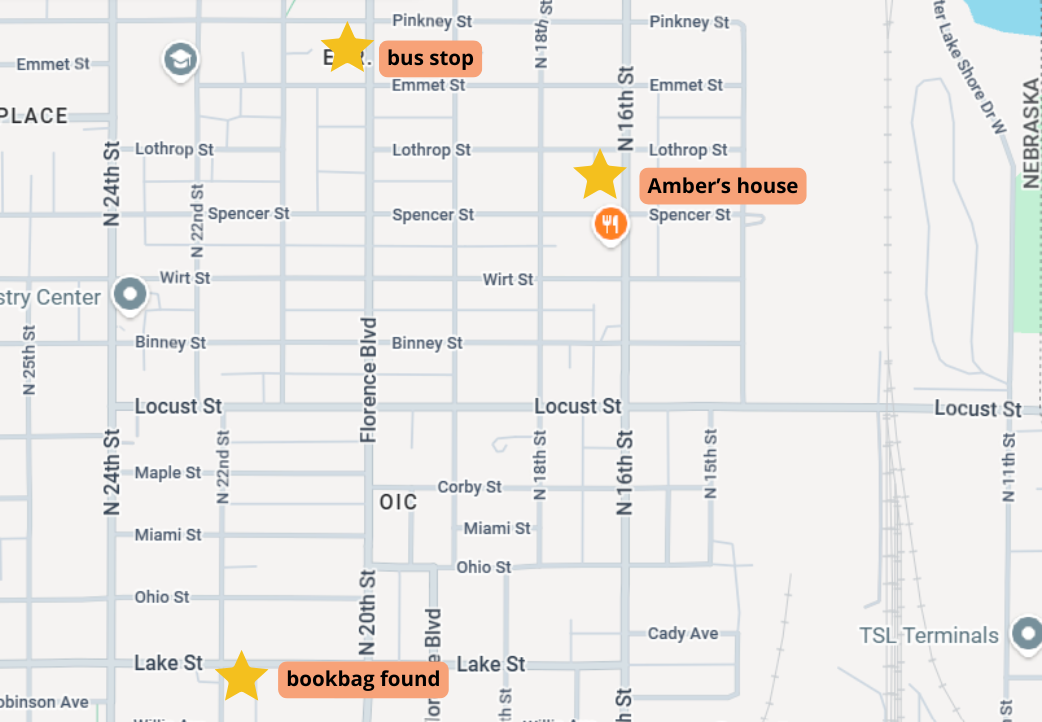
On February 14th, a man called 911 to report that he had found a bookbag in his outdoor trash bin. Inside the bookbag was a red notebook with the name Amber Harris.
Police arrived at the scene, a house on Lake Street less than a mile from the Harris residence, and took the bag into evidence. Surprisingly, the bookbag was clean and undamaged despite being missing for nearly three months. There were a few remnants of dirt and leaves, but nothing that would indicate that it had endured Nebraska’s winter weather for seventy-seven days.
In speaking with the residents of the house on Lake Street, investigators learned that it was a low-cost boarding house with people moving in and out on a regular basis. The man who had called 911 managed the house, and it was his girlfriend who had found the bookbag. The woman said she had been taking her dog for a walk in the alley behind the house when she looked inside one of the bins to see if the trash had been picked up. When she saw the bookbag, she knew that it hadn’t been there long – the day before, she had thrown a broken shoe in the bin, and the bookbag had been lying on top of it. She noticed how clean the bag was, so she took it inside thinking she could reuse it. When she saw the notebook with Amber’s name, she knew it was important and told her boyfriend to call the police.
Investigators found multiple items belonging to Amber inside the bookbag, including extra clothes that Amber often carried just in case – a jacket, a pair of jeans, and a bra. None of the items showed any sign of damage or evidence of blood, but they were sent to the lab for processing just the same. Hopefully there would be some small clue that could lead them to Amber.
Amber’s family was encouraged by the discovery of the bag. Someone out there knew something. Melissa told the World-Herald, “It gives you hope and it gives you more to follow. It’s been kept somewhere, we just don’t know where.”
The discovery of the bookbag also prompted the reclassification of Amber’s case from a runaway to “endangered missing”. Omaha Police Sgt. Teresa Negron told the World-Herald, “She’s too young to have sustained herself for this length of time. Obviously, as each day progresses, we get more concerned that something occurred.”
In early March, a team from the KlaasKids Foundation, a national organization that assists with missing children’s cases, coordinated a search of northeast Omaha. Nearly 200 volunteers showed up to help, fanning out across the city, tagging items of interest that would be sent to police for examination. KlaasKids coordinator Brad Dennis told the World-Herald, “We’re reminding people that this is a community that wants its daughter back.”
On May 11, 2006, two men walking through Hummel Park spotted something unusual just off the path. When they got closer, they realized it was part of a human skull. They called 911, and soon, dozens of police officers were at the scene. Investigators slowly excavated the shallow grave, revealing the remains of a young girl. She wore a single sock and a red sweater.
Investigators searched the area for additional evidence, but the park covered over 200 acres of mostly dense woods, making the search difficult. They recovered a few items of clothing and a shoe that lay nearby, but there was no clear indication of who had left the girl in the woods. Her body was sent to the medical examiner for identification and autopsy.
For over a week, the Harris family waited for their worst fears to be confirmed. Melissa told the World-Herald that they were trying to be patient and were holding onto hope. “We’ve got to be open to the possibility that it could be Amber. We just don’t know right now.”
Finally, on May 19th, police confirmed that the remains belonged to 12-year-old Amber Harris. The autopsy results would later reveal that she had died from blunt force trauma to the head. Her death was ruled a homicide.
In a press conference, Police Chief Warren stated, “We’ll be following up on numerous leads we have received in this case… The focus of our efforts now return to identifying individuals who are responsible for committing this crime, and we’re hopeful that we’ll be able to clear this case.”
On May 25th, Amber’s friends and family gathered together to celebrate her life. Over 500 people packed the church for her memorial service, and her school choir sang a song about hope. Melissa told the gathered mourners that they would continue to fight for justice for Amber. “This is just the beginning… We start Amber’s legacy right now.”
One week later, on June 2nd, the Omaha World-Herald ran a short story on the front page about the arrest of a sex offender on charges of domestic violence. The article pointed out that 52-year-old Roy Ellis, Jr. lived just one block away from where Amber Harris’ bookbag was found, but police declined to comment on whether Ellis was being looked at as a person of interest. A police spokesman told the World-Herald, “We will look at any sex offenders that live in the area where Amber was last seen.”
But official documents revealed what police were hesitant to say. In the early morning hours of June 2nd, Omaha police served a search warrant at Roy Ellis’ house. The warrant stated that they were looking for blood, bodily fluids, and fingerprints as well as clothing belonging to Amber Harris. During the search of the house, investigators seized a hammer, a shovel with a broken handle, several pairs of Ellis’ shoes, and an undisclosed amount of crack cocaine. They also seized several letters that Ellis had written to an ex-girlfriend while he was incarcerated.
According to official documents, Roy Ellis had been convicted of two counts of first-degree sexual assault on a child in 1999 and was sentenced to six years in prison. He was released in 2004 and was required to register as a Level 3 sex offender. But of course, that didn’t stop his violent behavior. In September of 2005, he broke into his ex-girlfriend’s house and choked her before forcing her into her car and driving her to Hummel Park. There, he took her into a wooded area and threatened to kill her. She managed to convince him to take her back home where her sister helped her get away. She called the police and made a report, but for some reason, there was no record of it. When she heard about the discovery of Amber Harris’ body in Hummel Park, she called police again. This time, the report was properly filed, and Roy Ellis was officially on investigators’ radar.
Ellis was charged with false imprisonment, terroristic threats, and violating a protection order, plus two counts of disturbing the peace. While in jail, investigators questioned Ellis about Amber Harris. They also took a sample of his DNA to compare against evidence in Amber’s case.
Finally, in February of 2007, Roy Ellis was charged with first-degree murder in the death of Amber Harris. The state announced that they would seek the death penalty.
One thing that frustrated investigators was the question of who had dumped Amber’s bookbag. Roy Ellis had been in jail in February of 2006 for unrelated charges, so he couldn’t have been the one to throw the bookbag into the trash bin. However, it was certainly possible that one of Ellis’ many acquaintances had taken care of the problem for him. In fact, Ellis had lived in the boarding house on Lake Street at one point in time, and he was allegedly friends with the man who ran it – the same man who had called the police to report the discovery of the bookbag. Investigators would only say that they had their theories about who had dumped it, but they didn’t have solid proof.
They did have proof of Roy Ellis’ involvement in Amber’s murder. Unsealed documents released to the press revealed a wealth of physical and circumstantial evidence against him. In the months before Amber’s body was found, Ellis had multiple conversations in which he incriminated himself in Amber’s case.
After Amber disappeared, Ellis repeatedly reached out to former neighbors asking if there had been any police activity at the boarding house; after the bookbag was found, those questions stopped. While he was in jail, Ellis told an inmate that he had sexually assaulted girls in the Omaha area, and he told another inmate that he had strangled a young girl.
One inmate told police that Ellis was seemingly obsessed with Amber’s case, cutting out newspaper articles and watching the evening news for updates. Another inmate said Ellis told him he had killed Amber and used a cloth to clean her blood out of his car. Ellis also bragged about taking women to Hummel Park and assaulting them, hitting them on the head if they fought him. He claimed to have done the same thing to Amber.
Ellis also had strange conversations with a corrections officer in March of 2006. He reportedly asked the officer how long it would take for a buried body to decompose, and he seemed distressed when the officer told him it could take a few years. Ellis also asked for books about forensic science and DNA analysis, and he asked the officer how long DNA would last on a human body if it was left outside in the woods. Several inmates reported that Ellis asked them similar questions.
Ellis was also caught on recorded jail phone calls telling his girlfriend that something bad had happened, but he didn’t want to tell her the details. He told a friend that he had left something at the boarding house that was “detrimental to my life” and that he needed to cover his tracks. It was possible he had asked someone to take care of it for him.
The biggest piece of evidence against Roy Ellis was his DNA. Forensic testing confirmed that DNA found on the inside hem of Amber’s jeans was a match to Roy Ellis. According to the forensic expert who examined Amber’s clothing, the DNA was in the shape of a large handprint. Roy Ellis could not explain why his DNA was found on Amber Harris’ jeans. He maintained that he had never met her.
In April of 2007, Roy Ellis was sentenced in his domestic violence case. The judge sentenced him to 60 years for being a habitual criminal and tampering with a witness, saying, “I consider you to be a menace. I owe it to society to protect them from you.”
One year later, in April of 2008, Roy Ellis’ murder trial began. Over the course of five days, jurors listened to expert testimony by investigators and forensic scientists. They listened to Amber’s family speak about her last days. They were shown gruesome photographs of Amber’s remains, which left many in the courtroom in tears. Finally, after long hours of deliberation, the jury found Roy Ellis guilty of the murder of Amber Harris. They ruled that he would be eligible for the death penalty.
Before his sentencing, Roy Ellis was evaluated by court psychiatrists. Ellis claimed to be schizophrenic, saying that he talked to the devil. His family members told the court that they believed he was faking his diagnosis and that his violent behavior was exacerbated by his drug use. His ex-girlfriend said, “There’s nothing wrong with him except for what he does to other people.” Ultimately, the psychiatrists couldn’t agree on Ellis’ mental state. A three-judge panel deliberated and sentenced Roy Ellis to death.
After the sentencing, Douglas County Attorney Don Kleine expressed his satisfaction with the results of the case. “On the spectrum of criminals, Roy Ellis is as bad as it gets… He’s preyed on people his entire life.”
Amber’s parents also expressed their relief at finally having answers. Michael told the World-Herald, “I’m relieved. I didn’t think I would be this relieved, but I am. There’s some justice today.”
Melissa wondered how she would carry on without her daughter. “I’m hoping she’s looking down on this from somewhere. Today was more for Amber than it was for us. This was justice for Amber.”
Amber Marie Harris was a bright, beautiful girl with her whole future ahead of her. She was kind and generous, outspoken and confident, a talented singer with a wonderful sense of humor. She deserved to grow up, deserved to live a full life surrounded by family and friends. May her memory bring comfort to those who loved her.