
A teenage girl vanishes in the middle of the night, leaving behind a trail of digital clues. Nearly a decade later, her family is still waiting for answers. What happened to Sophie?
Episode Media

Episode Sources
- Sophie Elizabeth Reeder – The Charley Project
- Sophie’s Light Foundation
- Looking for Sophie – Facebook
- Fort Lauderdale Police Department Press Release 6/29/2017
- Family Fears For Safety of Teen Missing For Weeks
- Missing Fort Lauderdale Teen May Be Victim Of Human Trafficking
- Missing teen’s parents worry daughter was trafficked
- Parents Of Missing Davie Teen Hoping For Tip In Daughter’s Disappearance
- She was walking down a street with her headphones on. She was never heard from again.
- Police release new surveillance video showing missing teen from 2017
- New details surface in case of Fort Lauderdale teen who went missing in 2017
- What Happened to Broward Teen Sophie Reeder, Missing Since 2017?
- Sophie Reeder’s Disappearance Haunts Family, Fort Lauderdale Police Detectives
- 15-Year-Old Who Disappeared Four Years Ago Had Visited Adult Websites
- Their Daughter Went Missing – Dr. Phil
- Fort Lauderdale Police continue 5-year-long search for missing girl
- Reward Reaches $25K in 2017 Disappearance of Fort Lauderdale Teen
- ‘We’ve hit a wall’: After five years, Fort Lauderdale teen Sophie Reeder is still missing
- Innocence Sold: ‘Kidnapping, human trafficking, murder.’ What happened to missing teen Sophie Reeder?
- Six years after Fort Lauderdale teen Sophie Reeder disappeared, family still searching
- Family desperate for answers eight years after disappearance of Florida teen, Sophie Reeder
- 8 years after Fort Lauderdale teen’s disappearance, $25K reward still offered for information
- Florida Teen Marks Date on Calendar with an “X” — Then Mysteriously Disappears
- On anniversary of Florida teen Sophie Reeder’s disappearance, family launches effort to protect other children
- Fort Lauderdale police hires psychic for Sophie Reeder case
- Fort Lauderdale Police hire psychic consultant in 2017 disappearance of teen Sophie Reeder
- Police, family of girl missing since 2017 turn to psychic for help
- Teen Left Behind $300 on Night She Disappeared. 9 Years Later, Family Uses It to Help Other Kids ‘Before It’s Too Late’
- Florida police consult psychics for help with Sophie Reeder cold case
Episode Transcript
Welcome back to Bite-Sized Crime. This week I’m bringing you a missing persons case that still needs answers. This episode discusses sensitive topics, so listener discretion is advised.
Sophie Elizabeth Reeder grew up in Fort Lauderdale, Florida, a large city on the Atlantic coast just north of Miami. Sophie was a sweet girl who loved art and music. She was smart and curious, deeply interested in the world around her.
As a child, Sophie was outgoing and confident, but as she approached her teenage years, she started to withdraw, becoming moody and reclusive. She started getting in trouble at school, and she exhibited several concerning behaviors such as starting small fires outside and cutting up her dolls. She also struggled with thoughts of self-harm, which greatly concerned her parents. Patrick and Nicole Reeder had divorced when Sophie was a toddler, and Sophie had stayed with her mom. But by the time Sophie was 12, she and Nicole were arguing a lot, and Sophie would often lash out in violence.
Eventually, it was decided that Sophie would go live with her dad for a while on the condition that she would start attending regular therapy sessions. Patrick was granted full custody in 2015, and although he and Nicole often disagreed about how to handle Sophie, they ultimately wanted what was best for her.
Things improved for a while, but when Sophie started high school, she fell into a downward spiral. Sophie started hanging out with kids her parents didn’t approve of, and she often skipped school, catching the bus into town. She got caught shoplifting, and the thoughts of self-harm returned. Her mood swings became worse, and she stopped going to therapy. A psychiatrist prescribed medication to help with Sophie’s anxiety and depression, but she didn’t like how it made her feel, drowsy and sluggish. She eventually stopped taking it altogether.
In January of 2017, Patrick made the decision to pull Sophie out of Stranahan High School and enroll her in online classes. He hoped that getting her away from the negative influence of her friends would help regulate her mood swings and let her focus on academics. Patrick told Dateline NBC that he tried to spend as much time with his daughter as he could, especially when she was feeling down. “We would just, you know, hop in the car, turn on the music, whatever she liked, and drive for like an hour or two, and it really helped her out.”
On the evening of Friday, May 19, 2017, Patrick noticed that Sophie seemed restless, texting on her cell phone as she paced the floor of their small house. Around 11:00, he told his daughter to go to bed, hoping a good night’s sleep would help her settle. When Patrick awoke the next morning, Sophie’s bedroom door was closed, so he figured she was sleeping in like she usually did on the weekend. Patrick left the house to run a few errands, but when he returned, Sophie’s door was still closed. He quietly opened the door to check on her and was surprised to see that she wasn’t in her room. Her laptop sat on the bed, and a candle had been left burning, suggesting that she was planning to come right back. Sophie often took long walks around the neighborhood to clear her head.
Patrick texted his daughter to ask where she was, but there was no response. He tried calling, but her phone went straight to voicemail. He noticed that the wall calendar in her room had an X marking yesterday’s date – May 19th – and he wondered if Sophie had something planned for that day. Maybe she had taken the bus to her mom’s house to visit. But when Patrick called Nicole, she told him that Sophie wasn’t there.
Patrick searched the neighborhood, a quiet row of houses along a canal, but there was no sign of Sophie. He called his father to ask for advice, and his dad told him to call the police. However, Patrick believed he had to wait 48 hours before he could file a missing persons report – a common misconception – and he hoped that Sophie would come home on her own.
But Sophie didn’t come home, and Patrick knew he couldn’t wait any longer. On Monday, May 22nd, he went to the Fort Lauderdale Police Department and told them that Sophie was missing. An officer took the report but told Patrick that Sophie was a teenage girl, she had probably run off and would come back soon. Patrick really wanted to believe that was true. He told the Sun Sentinel, “That lady I did the report with on Monday morning, she said, ‘They usually come back within a week.’ I was like, ‘OK, this must be the timeline.’ I have no detective experience, just what I see on TV, that’s it.”
Fort Lauderdale police didn’t start looking for Sophie right away, but her family did. They searched her bedroom for clues and found a large sum of money in a bag by her bed – $300 in cash. Sophie didn’t get a large allowance and she didn’t have a job, so where had the money come from?
They also flipped through the pages of her diary, which gave them a glimpse of her mental state in the days and weeks before she disappeared. Sophie wrote about feeling misunderstood, how nobody in her life seemed to really get her. “I’m used. Unwanted. Unloved. Lonely. I’m like the penny you dropped under the sofa. But you don’t care cuz hell it’s just a penny.”
Then, one of Sophie’s cousins managed to get into her laptop, and what they found was shocking. Sophie had been accessing online chatrooms and “sugar daddy” websites, places for older men to seek out younger women and girls. Sophie’s family couldn’t tell if she had actually signed up for any of the sites or made contact with any other users, but the mere fact that a 15-year-old girl was looking into this kind of content was extremely concerning.
Another diary entry from months prior confirmed that these internet searches weren’t a fluke. Sophie had written, “What to do when I’m 15: Make 10 new friends. Go to the beach 3 times a week. Get 10 sugar daddies.”
Sophie’s friends said that she had talked about wanting a sugar daddy for a while, but they thought she was joking. She had even told them she was meeting up with people and that one man had paid her $400. Her friends thought she was just making stuff up to sound cool, but some of her stories were disturbing. Sophie had confessed to a friend that a man had raped her in a hotel room. The friend hadn’t known what to say. She hoped it was just another one of Sophie’s wild stories.
When police finally got around to investigating Sophie’s disappearance, they still treated her like a teenage runaway. A single post on the department’s Facebook page dated June 5th merely stated that Sophie was a missing juvenile last seen leaving her house. No other information was included. It wasn’t until June 29th, six weeks after her disappearance, that the Fort Lauderdale Police Department issued a formal press release requesting help from the public in locating Sophie Reeder.
Sophie’s parents were beside themselves with worry. Patrick told NBC Miami, “It’s been a lot of ups and downs, frustrations and roadblocks, endless nights. I wake up in the middle of the night and sleep on the couch, wait by the front door to see if she’ll walk through. I do everything I can to try and find her.”
Frustrated with the lack of police response, Nicole hired a private investigator to help with the search. The investigator told NBC Miami, “Sophie may have left the house voluntarily on her own, but she’s not coming back for a reason. She’s either being held or something a lot worse.”
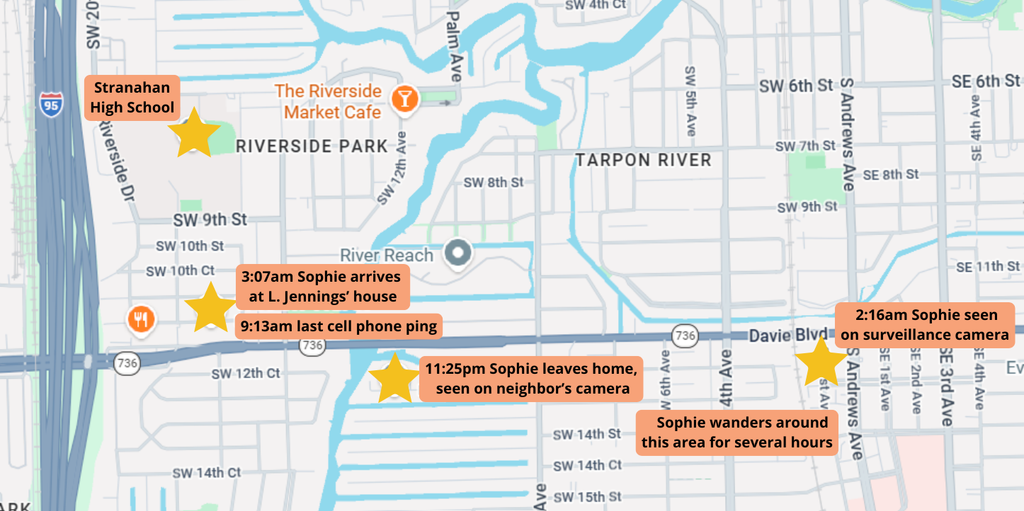
Police did get access to Sophie’s cell phones, of which she had two, and used the data to track her movements on the night she disappeared. They gathered footage from security cameras in the area that showed Sophie’s path. She left her house around 11:25pm and headed east down Davie Boulevard before turning south on Andrews Avenue. After a while, she turned north again, walking towards her house, but she didn’t go home. Instead, she walked around for a few hours before heading towards Stranahan High School. According to detectives, it seemed as though Sophie was just wandering without any real purpose.
In an attempt to generate new leads, police released a short surveillance video of Sophie walking down Davie Boulevard in the early morning hours of May 20th. She was wearing red Converse sneakers and a short black dress under a brown fur coat, an odd choice for the Florida humidity. Sophie seemed calm and unbothered in the video, strolling along with her headphones on. Eerily, the video also showed a police cruiser driving past her, unaware that the girl on the sidewalk would soon vanish.
A fifteen-year-old girl wandering the streets of Fort Lauderdale at night was troubling – what had Sophie been doing, and what kind of danger could she have run into? While digging through Sophie’s call log, investigators discovered that she had made dozens – if not hundreds – of phone calls to the same number in the months before her disappearance. The number belonged to a 37-year-old convicted felon named Leonard Jennings. Jennings had a long list of drug charges and had served time for theft and assault. Jennings lived close to Stranahan High School, and according to Sophie’s friends, she would often purchase marijuana from him. Jennings was the last person Sophie called on the night she disappeared.
Phone records showed that around 2am on May 20th, as Sophie meandered in the area of Andrews Avenue, she turned north and placed a call to Jennings. She started heading towards his apartment complex, about a two-mile walk. She was captured on surveillance camera at 2:16. At 3:07, Sophie called Jennings again, this time from outside his apartment on SW 11th Court. According to the Orlando Sentinel, Sophie had already been to Jennings’ apartment earlier in the day on May 19th, presumably to buy weed. So why was she showing up at his place again in the middle of the night?
The data showed that Sophie’s cell phone remained at Jennings’ apartment for the next six hours. Its final ping was at 9:13am when it disconnected from the network. Investigators couldn’t find any surveillance cameras showing Sophie in the area after 3am, making them wonder if she had ever left Jennings’ apartment.
When police questioned Leonard Jennings, he denied having any contact with Sophie that night. Jennings lived with his mother and two brothers, who stated that they didn’t know Sophie and had not seen her at all on the morning of May 20th. But Sophie’s cell phone data said otherwise.
Investigators also talked to Jennings’ neighbors, hoping that someone had seen Sophie that night. Another resident of the apartment complex was 41-year-old John Mobley, who was well-known to Fort Lauderdale police. Mobley had long been suspected of human trafficking, but police had never been able to get enough evidence to make an arrest. When detectives knocked on his door to ask about Sophie, Mobley was angry and told them to come back with a search warrant. Unfortunately, they didn’t have enough probable cause to get one.
However, they did have enough cause to get a search warrant for Jennings’ apartment. On July 11th, two months after Sophie disappeared, Fort Lauderdale police executed the search warrant, which specified that they were looking for evidence of kidnapping, human trafficking, and murder. Investigators seized a host of digital devices, including 25 cell phones, 3 tablets, 2 computer towers, 3 digital cameras, a hard drive, and a camcorder. They also took a journal, a pair of headphones, a wig, and some live ammunition. Ultimately, they were unable to connect any of the items to Sophie.
After that, Sophie’s case went quiet. Police conducted a few more searches of the area, but it truly seemed as though Sophie Reeder had vanished into thin air. In May of 2018, after Leonard Jennings and John Mobley had moved out of the apartment complex, police searched both now-vacant units, dusting for fingerprints and using luminol to test for traces of blood. But the searches came up empty.
Through it all, Sophie’s parents tried to stay positive, holding onto the hope that she would come home someday. Nicole told CBS Miami that she just wanted to talk to her daughter again. “I’d like to say to Sophie that no matter what has happened, no matter what you’ve gone through, what you’re going through, if you are still able to come home, we love you. We’ll take care of you.”
As the years passed, police tried to keep Sophie’s case active. In 2019, her story was featured on the show “In Pursuit with John Walsh,” which brought new attention to the case. Dateline picked up the story in 2020, and detectives gave new interviews to local news stations. Detective Jennifer Saint-Jean told WSVN, “The grim reality is, Sophie could be in a very dark situation right now, which is why we’re hoping for any tips or any leads that could get us information so that we could locate her safely.”
In May of 2022, on the five-year anniversary of Sophie’s disappearance, Fort Lauderdale police released a new video of the case, hoping to generate new leads. They also announced a $25,000 reward for information leading to Sophie’s recovery. Four months later, they announced the creation of the Endangered Persons Unit, a new department that would focus on missing persons cases and call in experts on human trafficking and child exploitation.
In 2023, Florida passed new legislation that required all police recruits to receive training in detecting human trafficking. Nicole told the South Florida Sun-Sentinel that she was hopeful the law would benefit others in Sophie’s situation. “I am glad that this subject is being taken more seriously, and hope more young girls can be saved.”
In 2026, Sophie’s aunt Kirsten launched the Sophie’s Light Foundation, a nonprofit organization dedicated to educating children and families about the dangers of human trafficking and how online spaces can be used to prey on minors. Kirsten, a teacher by trade, told Dateline that her goal was to create a curriculum for schools that could teach children how to set safe boundaries online. “We used to be afraid of candy from strangers. And now it’s digital candy. It’s scary. It’s really scary.”
As of this recording, Sophie Reeder has been missing for nine years. Her family has not given up hope that she will someday come home. Nicole told the Sun-Sentinel, “We can never give up on Sophie and her return. Miracles do occasionally happen.”
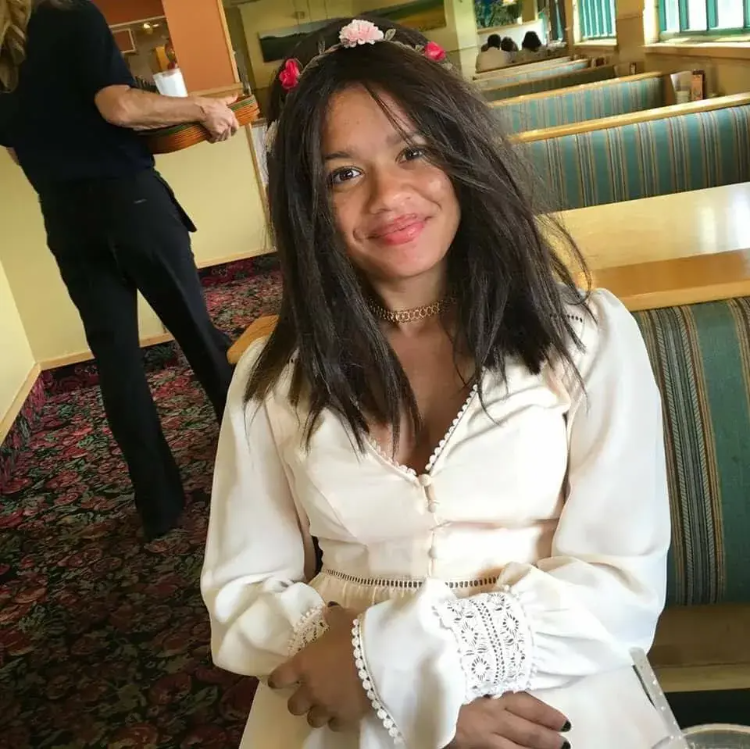
Sophie Elizabeth Reeder was last seen on the morning of May 20, 2017, walking westbound on Davie Boulevard in Fort Lauderdale, Florida. She was wearing a black dress, brown fur coat, red Converse sneakers, and white headphones. She is described as a Black female with brown eyes and curly brown hair. She is 5’1” tall and weighs approximately 100 lbs. At the time of her disappearance, Sophie was 15 years old; she would be 24 today.
If you have any information about the disappearance of Sophie Reeder, please contact the Fort Lauderdale Police Department at 954-828-6677 or email SophieTips@fortlauderdale.gov.
If you or someone you know is struggling with mental health or emotional distress, please contact the 988 Lifeline to talk to someone who cares. Call or text 988 from any cell phone, or chat with a counselor online at 988lifeline.org. Help is available 24/7.
Human Trafficking Resources
If you are a human trafficking victim or have information about a potential trafficking situation, call the National Human Trafficking Resource Center at 1-888-373-7888 or text 233733.
If you believe a child is being trafficked, submit a tip through the National Center for Missing & Exploited Children‘s CyberTipline or call 1-800-THE-LOST.