
Two young women vanish from the same small community, leaving their families without any answers. Where are Kelly and Shemika?
Episode Media



Episode Sources
- Kelly Lynette Allen – The Charley Project
- Mother anxiously waits for news of missing daughter
- TV One’s ‘Find Our Missing’ features St. Louis case on Monday
- Family of missing Berkeley woman not giving up, 10 years after disappearance
- Missing from Missouri: Could New Image Bring Kelly Allen Home?
- NCMEC releases age-progressed image of Kelly Allen 19 years after her disappearance
- New age progression photo renews search for St. Louis woman’s 2007 disappearance
- Shemika Keyanta Cosey – The Charley Project
- Family searching for missing teen
- Family still looking for answers five years after teenager disappears
- Vacant homes searched for missing people
- Fresh eyes, fresh wounds for those missing loved ones
- Mom still searching for answers after daughter ‘vanished without a trace’ over 10 years ago
- Families of missing black Americans fight for media, police to focus on their loved ones’ cases
- One small St. Louis County town is missing dozens of teens
- ‘My daughter is important too’: Exploring racial disparities in missing women’s cases
- Missouri bill aims to address crisis of missing African American women and girls
- New photo may help solve Missouri cold case
- Artificial intelligence aids in search for missing Berkeley teen
- Berkeley Police digging up yard in missing teen case
- No human remains at Berkeley dig site: Police
- Missouri State Highway Patrol
- Humans of St. Louis
- Searching for Shemika Facebook
Episode Transcript
Welcome back to Bite-Sized Crime. This week I’m bringing you two cases from the same town, a town that seems to have an epidemic of missing people. This episode discusses sensitive topics, so listener discretion is advised.
Berkeley, Missouri is a small community of just over 8,000 people nestled in the inner-ring of the city of St. Louis. Originally founded in 1937 by white residents wanting to segregate parts of St. Louis, in particular the school system, Berkeley’s population has been in slow decline since the 1970s. It is now considered a low-income suburb with a high crime rate. One of its main issues is a high rate of missing persons cases.
According to the Missouri State Highway Patrol, there are currently 16 active missing persons cases in Berkeley, and 9 of them are children. Between 2000 and 2017, 33 children disappeared, an alarming number for such a small community. While some cases are taken on by the St. Louis city or county police, the majority are handled by the Berkeley PD, a small department with limited resources. This could be a contributing factor in the two cases we’re looking at today.
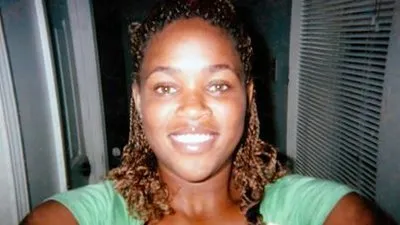
The first case is that of 20-year-old Kelly Lynette Allen. In the spring of 2007, Kelly was a nursing student living with her mother near downtown St. Louis. She had a job working as a caregiver at a nursing home outside the city, but the commute was long, and it was beginning to wear on her. She really wanted to find a job closer to home.
On March 7, 2007, Kelly headed to Berkeley to stay with a friend while searching for jobs in the area. It was just 15 minutes from home, a much better commute than what she currently had. She crashed on her friend’s couch at night and pounded the pavement during the day, handing out her resume and setting up interviews. She checked in with her mom every so often to catch her up on how the job hunt was going.
On the morning of March 13th, Kelly’s friend left the apartment to go to work. Kelly was still asleep on the couch – she had an interview later that day, so her friend let her sleep a bit longer. When Kelly eventually awoke, she got dressed and headed out. Her interview was for a telemarketing company, and it must have gone well, because they asked Kelly to come back for a second interview on the 16th. Kelly headed back to the apartment and called her friend to let her know the good news. They arranged to hang out later after work. But when Kelly’s friend came home, Kelly wasn’t there. All of her belongings were still in the apartment, including her purse.
It’s unclear how long Kelly’s friend waited before she realized Kelly wasn’t coming back, but at some point she reached out to Kelly’s mom Tracy to let her know what was going on. Tracy then waited another two days – perhaps believing her daughter would return at any moment – before she finally contacted the police. She would later say that she deeply regretted waiting so long.
By the time Kelly’s disappearance was reported to the St. Louis Metropolitan Police, her friend’s apartment had been cleaned and Kelly’s family had retrieved all her belongings. There was no way to properly secure the apartment as a potential crime scene. Investigators talked to Kelly’s friend and the friend’s boyfriend as well as Kelly’s boyfriend, but nothing seemed to come of it, and any leads police had soon dried up.
Months passed with no sign of Kelly. Her $2,000 tax refund check was never cashed – surely if she had walked away voluntarily she would have taken that money. Her family hung flyers all over St. Louis and even hired a private investigator to help with the search, but it was becoming increasingly clear that Kelly had likely met with foul play. Her family believed she would have reached out if she could.
Shortly after the one-year anniversary of Kelly’s disappearance, an anonymous phone call was made to Berkeley City Hall. The tipster said that Kelly had been buried in a backyard in Berkeley. According to the St. Louis Post-Dispatch, investigative teams searched the yard and recovered a bone, but testing did not connect it to Kelly and the trail went cold yet again.
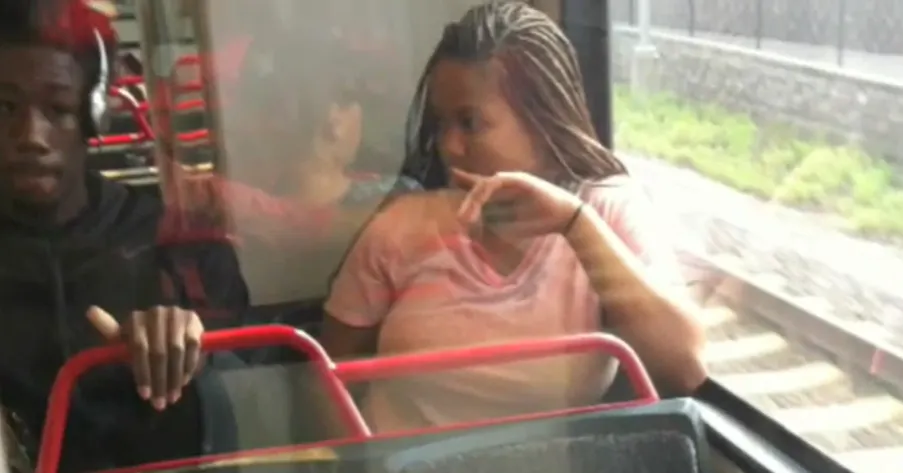
In 2012, Kelly’s cousin was on the city metro when he spotted a woman who looked like Kelly. Startled, he snapped a picture of the woman and the man she was sitting next to. At this point, Kelly had been missing for five long years, and her cousin wasn’t confident enough in the woman’s identity to approach her. Instead, he sent the picture to the police. If investigators were ever able to make contact with the woman in the photo, they never made that information public.
As of this recording, Kelly Allen has been missing for 19 years. Her family still believes she will come home some day. Her sister Brooke told KTVI that they are holding onto hope. “It’s heartbreaking daily, it’s a struggle. But we keep our faith that everything’s going to be alright and she’ll come home to us.”
In 2026, the National Center for Missing and Exploited Children released an age-progressed image of Kelly, who would be 39 years old today. Her case is still open and active. The St. Louis Metropolitan Police Department issued a statement saying, “Our detectives continue to investigate this case in conjunction with the Berkley Police Department. We still have hope that Kelly will be found and reunited with her family.”
Kelly Lynette Allen was last seen on March 13, 2007, at the Frost Apartments near Interstate 170 in Berkeley, Missouri. She is described as a Black female with brown hair and hazel eyes, standing 5’4” tall. She has a tattoo of two brown eyes and a rose on her left shoulder and a half-moon tattoo behind her left ear. At the time of her disappearance, she was wearing jeans, a blue blazer, and sparkly silver shoes.
If you have any information about the disappearance of Kelly Allen, please contact the St. Louis Metropolitan Police Department’s Missing Persons Unit at 314-444-5738.
Less than two years after Kelly disappeared and just two miles away, someone else went missing – this time, a teenage girl vanishing in the middle of the night.
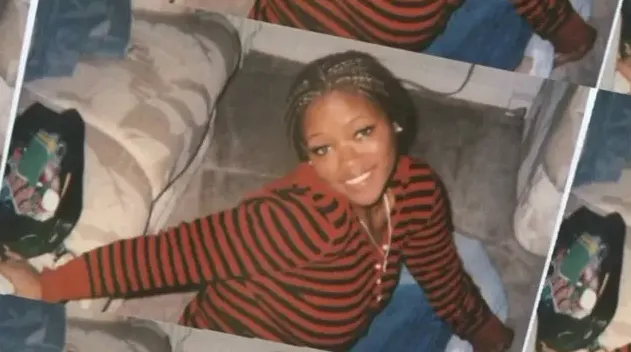
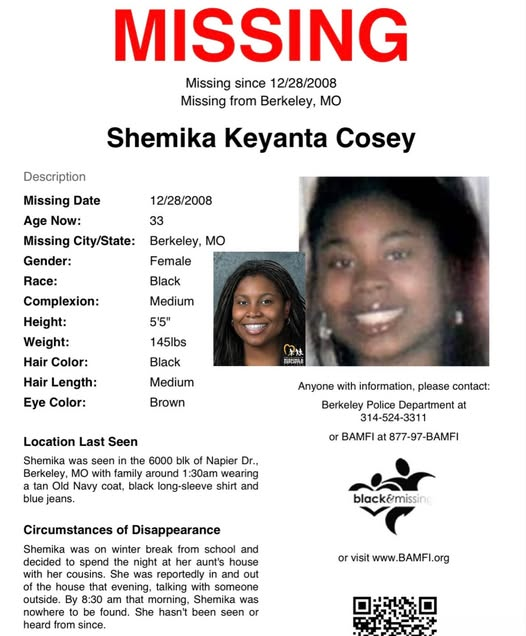
On December 28, 2008, a few days after Christmas, 16-year-old Shemika Keyanta Cosey spent the day shopping with her mother and grandmother. Later that evening, she asked her mom Paula if one of her cousins could come over to the house and hang out. When Paula called her sister, Shemika’s aunt, she was told that the cousins were about to watch a movie – would Shemika like to come over and join them? Before long, Shemika had packed her overnight bag and was hopping into her cousin’s car.
The next morning, Paula’s sister called her. They couldn’t find Shemika – was there any chance she had made it back home? Unfortunately, the answer was no. Somehow, in the middle of the night, the teen had vanished.
Paula immediately drove to her sister’s house in Berkeley. Together, the family went over the events of the night before. Shemika and her cousins had watched a movie before going to bed, but according to the cousins, Shemika had left the house several times throughout the night. It appeared as though someone had been outside trying to get her attention. Eventually everyone fell asleep, but when they woke the next morning, Shemika was gone. She had taken her coat and purse, but left her overnight bag behind. The front door was unlocked and slightly ajar as if she had been planning to come back and wanted to make sure she could get in the house.
Paula contacted the Berkeley Police Department and reported Shemika missing. However, they didn’t seem to take Shemika’s disappearance seriously and wrote her off as a runaway, in spite of the fact that she had never done anything like this before. Paula later told KOMU, “I don’t know what they were thinking, but in their head, to me, it felt like that my daughter wasn’t worth looking for.”
Paula wasn’t going to sit around and wait for police to take action. She rallied the family, getting them to drive around the city, hanging flyers and talking to neighbors. They called everyone they knew, anyone who might be even remotely connected to Shemika, hoping that someone had seen her.
Days passed, then weeks. Paula had to consider the grim possibility that her daughter had somehow met with foul play. Shemika might have left the house on her own, but there was no way she would stay gone this long unless something was preventing her from coming home.
While Shemika was a good kid, she was also a typical teenage girl who liked to test her boundaries. Paula had once caught her with a fake ID that she had been using to sneak into local clubs, and she had recently started smoking cigarettes. Paula worried that her daughter was hanging around people who might not have the best intentions. Paula told Berkeley detectives about all of this, but it seemed to just solidify their belief that Shemika had run off on her own.
As the months and years went by, Shemika’s family refused to give up. They started a Facebook page dedicated to finding Shemika and sharing stories of other missing people. Paula even started a support group for families with missing loved ones. She told ABC News, “I still have hope. I still have hope that one day, I’m gonna find my child.”
Several years after Shemika disappeared, Paula found a notebook among her daughter’s things. Inside, there were messages that Shemika had written to a friend several months prior to her disappearance, notes written in class and passed back and forth. In the messages, Shemika wrote about a boyfriend and her belief that she might be pregnant. Was it possible that this had something to do with why she left her aunt’s house in the middle of the night? If she met up with this boyfriend, had he done something to harm her?
In 2024, the National Center for Missing and Exploited Children released an age-progressed image of Shemika as she might look at the age of 32. Paula told KSDK that she was hopeful the image would generate new leads for investigators, and she sent a special message to her daughter. “I pray every day that you find a way home to your family. I miss you. I love you. I pray that I see you one day in this life. My baby needs to be home with me.”
Shemika’s case sat on the shelf for years until 2026, when Berkeley detectives reopened the file and found something important: a tip from years earlier that suggested there might be human remains buried at a property just blocks away from the house where Shemika disappeared.
On March 31st, crews descended on Jefferson Avenue in Berkeley, searching the yards of six homes before settling on one in particular where cadaver dogs hit on a spot in the backyard. Digging first by hand and then with heavy machinery, investigators recovered a bone and several bone fragments that were immediately sent to the lab for analysis. Ultimately, the bones were determined to belong to an animal, not a human. On April 2nd, Berkeley police suspended the search due to inclement weather but stated they would soon start digging again. As of this recording, there have been no further updates, and Shemika’s case is still open.
Shemika Keyanta Cosey was last seen on December 29, 2008, at a home on Napier Drive in Berkeley, Missouri. It is believed she left the house sometime between the hours of 1:30am and 8:30am. She was wearing a tan jacket, blue jeans, and a black long-sleeved shirt. She is described as a Black female with black hair and brown eyes, standing 5’5” tall. At the time of her disappearance, she was 16 years old; she would be 33 today.
If you have any information about the disappearance of Shemika Cosey, please contact the Berkeley Police Department at 314-524-3311.
Kelly Allen and Shemika Cosey are just two of the thousands of missing Black women and girls across the United States. They have families who love them and miss them. Their cases deserve the same attention as everyone else’s. Please share their stories so we can bring them home.